Table of Contents
Last Updated: October 23, 2026
Quick Summary
To verify restaurant allergen safety, check the restaurant’s allergen menu and website before you go, then ask staff specific questions about ingredients, cross-contact controls, and who in the kitchen confirms your order. Grade each answer on whether it comes from a written source and describes an actual mechanism, and leave if the answers stay vague after you escalate to the manager.
- A 2026 Allergy Dining Report found 54% of diners look for allergens marked next to each menu item.
- Ask the five questions one at a time and let the server finish before asking the next.
- Hand the kitchen a written allergy notice and ask that the chef confirm the order.
- Tier 1 diners with anaphylaxis history should require a written allergen system and a named kitchen confirmation.
- Use epinephrine at the first sign of a severe reaction, then call 911.
Table of Contents
- Why Restaurant Allergen Safety Is Hard to Confirm
- Step 1: Check the Restaurant Allergen Menu and Website Before You Go
- Step 2: Ask the Right Restaurant Food Allergy Questions
- Step 3: Use a Food Allergy Dining Card Template
- Step 4: Confirm Food Allergy Cross-Contact Prevention in the Kitchen
- Step 5: Know the Limits of an Allergen-Free Claim
- Step 6: Decide Whether to Order, Modify, or Leave
- What to Do If a Reaction Happens While Dining Out
- Frequently Asked Questions
Why Restaurant Allergen Safety Is Hard to Confirm
A 2023 review in PubMed Central found that restaurant dining poses a real risk for people with food allergies because allergen labeling is inadequate and inconsistent (Food allergy risks and dining industry – an assessment and a path forward).
At Daré Vita Café, we built our kitchen around this exact problem. Below, we’ll show you exactly how to check a restaurant before you order, what to ask, and when to walk away.
The core issue is simple. Most restaurants don’t have a written allergen system. They have a verbal one. And verbal systems fail when the kitchen gets busy.
Step 1: Check the Restaurant Allergen Menu and Website Before You Go
Start online, before you leave home. A 2026 Allergy Dining Report found that 54% of diners look for allergens clearly marked next to each menu item, and 31% check for a dedicated allergen page on a restaurant’s website.
Here’s what to look for:
- A dedicated allergen page, not just a note at the bottom of the menu
- Allergens listed next to each dish, item by item
- A clear statement about how the kitchen handles cross-contact
If the restaurant allergen menu is vague, that tells you something. “Gluten-free options available” is not a system. It’s marketing.
A menu label alone does not make a meal safe. The American Academy of Allergy, Asthma & Immunology notes that even trace amounts can cause life-threatening reactions. Treat online information as a starting point, never a guarantee.
Step 2: Ask the Right Restaurant Food Allergy Questions
The right restaurant food allergy questions get specific answers. Vague questions get vague answers, and vague answers are dangerous. Most published guidance stops at “tell your server about your allergy.” That is not a verification method.
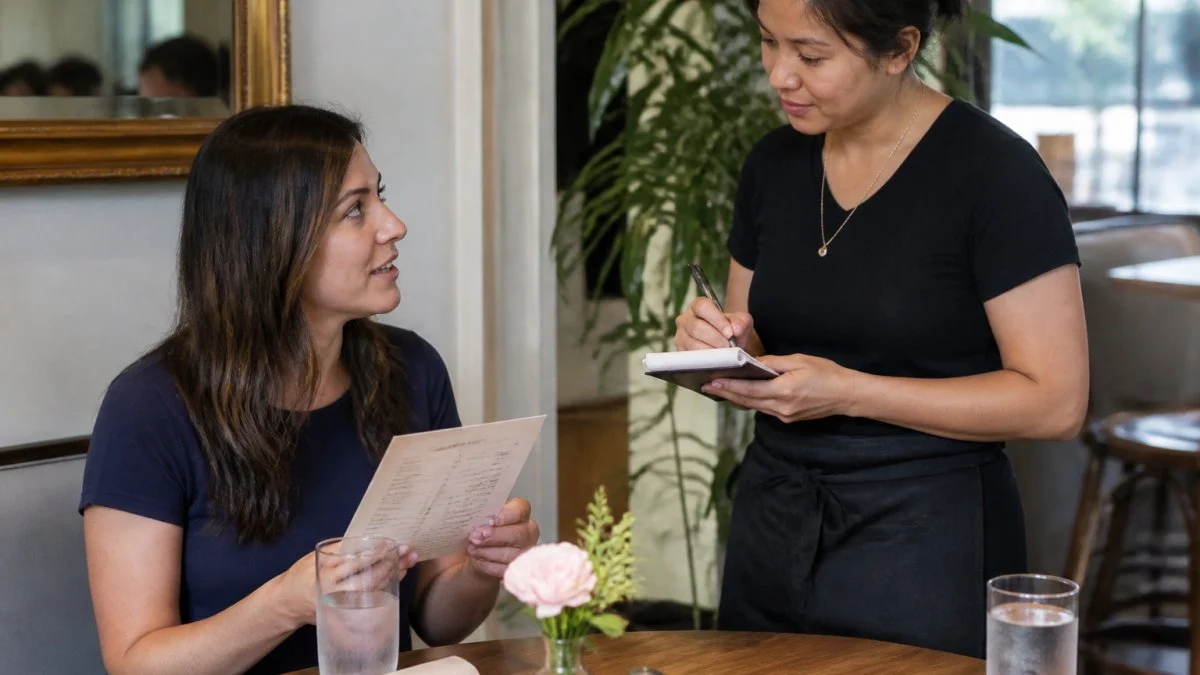
The Five Questions, In Order
Ask these one at a time and let the server finish. The sequence matters because each answer tells you whether the next question is worth asking.
- “Which dishes on your menu contain my allergen?” A correct answer names specific dishes or says the kitchen keeps a written allergen matrix. An incorrect answer is “probably none” or “I think you’re safe with the salads.”
- “Can you show me the ingredient list for this dish, or check with the chef?” A correct answer is “I’ll bring the spec sheet” or “let me confirm with the chef.” An incorrect answer is a recitation from memory.
- “How do you prevent cross-contact for this dish, separate surfaces, utensils, and fryers?” A correct answer names the mechanism: a dedicated cutting board, a cleaned and sanitized prep area, a separate fryer, or foil on the grill. An incorrect answer is “we’re careful.”
- “Who in the kitchen confirms my order when it comes in, and does the chef sign off?” A correct answer names a role, the chef, the expo, the kitchen manager, and describes a ticket marked for allergy. An incorrect answer is “the kitchen will see the note.”
- “What training does your staff have on food allergies?” A correct answer references a food-protection manager on duty, an allergen training program, or a written procedure. An incorrect answer is “we all know the menu.”
How to Judge the Quality of the Answers
Good answers are specific. Bad answers are fast. A server who says “I’ll check with the chef” is doing it right. A server who says “I’m sure it’s fine” is guessing.
Grade each answer against these signals:
- Source: Did the staff check a written source, a binder, a tablet, a spec sheet, or answer from memory?
- Specificity: Did they name the actual ingredients in the dish, or speak in generalities?
- Mechanism: Did they describe how the kitchen cleans equipment and separates utensils between orders, or just promise to be careful?
Escalate to the Manager Before You Order
If any answer is vague, ask for the manager or the chef on duty. This is not a complaint; it is a normal request, and a well-run restaurant will treat it that way. When the manager arrives, repeat questions 3 and 4, cross-contact controls and kitchen confirmation, because those are the two a server is least likely to know and most likely to guess at.
A confident tone is not evidence. The most dangerous answer in a restaurant is a fast, friendly “oh, that’s definitely gluten-free” from someone who has not left the table to check. Treat certainty without verification as a red flag, not a green one.
If the answers are hesitant, dismissive, or inconsistent after escalation, that is your answer. Move to the decision framework in Step 6.
Step 3: Use a Food Allergy Dining Card Template
A food allergy dining card template removes guesswork. It puts your needs in writing so nothing gets lost between the table and the kitchen.
Here’s a template you can print and fill in:
ALLERGY NOTICE
Name: __________
I am allergic to: __________
Severity: __________ (e.g., anaphylaxis, requires EpiPen)
Please confirm: (1) this dish contains none of these ingredients, (2) separate utensils and surfaces are used, (3) the chef has reviewed this order.
Chef signature or confirmation: __________
Hand it to your server. Ask them to give it to the chef. A kitchen that takes allergies seriously will appreciate the clarity.
Step 4: Confirm Food Allergy Cross-Contact Prevention in the Kitchen
Food allergy cross-contact prevention is where most restaurants fall short. Cross-contact happens when an allergen touches a safe food through shared surfaces, utensils, or oil.
The CDC reports that training personnel and providing ingredient lists for menu items can reduce the risk of allergic reactions (the CDC). Ask whether the kitchen does these things:
- Uses separate cutting boards and utensils for allergen-free dishes
- Cleans and sanitizes equipment between orders
- Uses dedicated fryers or cooking surfaces
- Stores allergen-free ingredients away from common allergens
A 2025 review in PubMed Central recommends structured allergen-management procedures, including clearly labeling allergen-free options. Structured beats improvised every time.
Step 5: Know the Limits of an Allergen-Free Claim
An allergen-free claim means the dish was made without that ingredient. It does not always mean the dish is free of traces. That gap matters.
The difference is between allergen absence and reduced cross-contact risk.
Ask directly: “Is this dish made in a dedicated area?” If the answer is no, decide whether the risk works for you. For mild sensitivities, it might.
Step 6: Decide Whether to Order, Modify, or Leave
Most allergen guides tell you to “communicate with staff” and stop there. They never tell you what to do when the answers are ambiguous, which is the situation you will actually face. Use this framework to make the call.
First, Tier Your Own Risk
Before you read the restaurant, read yourself. The same restaurant can be a reasonable choice for one diner and an unacceptable one for another.
- Tier 1, Anaphylaxis history or epinephrine prescription. Your threshold for ordering should be a written allergen system, a named kitchen confirmation, and a described cross-contact control. Anything less is a leave.
- Tier 2, Moderate reaction history (hives, vomiting, significant discomfort) without anaphylaxis. You can accept a shared kitchen if the staff can describe the cleaning and separation steps and the dish is simple.
- Tier 3, Mild sensitivity or preference. You have the most room to modify, but the verification questions still apply.
Then, Match the Restaurant to Your Tier
| What You Found | Tier 1 | Tier 2 | Tier 3 |
|---|---|---|---|
| Written allergen menu, trained staff, named chef confirmation, described cross-contact controls | Order | Order | Order |
| Good answers but shared fryer or shared prep surface | Leave, or choose a dish with no cooking step | Modify or choose a simpler item | Modify |
| Vague answers, no written system, dismissive staff | Leave | Leave | Leave |
| Staff cannot name ingredients after manager escalation | Leave | Leave | Leave |
What “Modify” Actually Means
Modifying a dish is not the same as asking the kitchen to “leave off” an ingredient. A modification only reduces risk when it removes a cooking step or a shared surface. Useful modifications include choosing a dish that is assembled rather than cooked, asking for a plain grilled protein with no sauce, or selecting an item that does not pass through the fryer.
When to Leave
Leave when any of these is true:
- The staff cannot name the ingredients in a dish after you have asked twice.
- No one can describe how equipment is cleaned between orders.
- The manager is annoyed by the questions.
- You are Tier 1 and the kitchen cannot confirm a dedicated surface or fryer.
The best restaurants won’t be offended when you leave. They’ll understand. A kitchen that pushes back on allergy questions is telling you what it values. You do not owe anyone an explanation for protecting your own safety, and a polite “I don’t think this will work for me tonight” is a complete sentence.
What to Do If a Reaction Happens While Dining Out
Act fast and don’t wait to see if it gets worse. If you carry an epinephrine auto-injector, use it at the first sign of a severe reaction.
Tell the staff immediately so they can help and stop serving the dish. Keep your dining card or order details handy for the paramedics.
Anaphylaxis can escalate in minutes. Emergency planning while dining out means knowing your exit, your medication, and your emergency contacts before you sit down.
Frequently Asked Questions
What questions should you ask restaurant staff about allergens?
Ask whether the kitchen has a written ingredient list for the dish, who prepares it, and how equipment and surfaces are cleaned between orders. Ask if a manager can confirm the answer and whether the restaurant follows structured allergen procedures. The CDC reports that training personnel and providing ingredient lists can reduce the risk of allergic reactions, so answers that reference an actual list or process are stronger than a casual “I think it’s fine.”
Can a restaurant guarantee a meal is free from an allergen?
Rarely. A menu label or allergen-free designation alone does not establish that a meal is safe for a particular diner. The American Academy of Allergy, Asthma & Immunology advises diners to tell staff about their allergy and notes that even trace amounts can cause life-threatening reactions. Treat any assurance as a statement about reduced risk, not a guarantee, and decide whether that level of risk works for you.
How can you check whether a restaurant prevents cross-contact?
Ask about the specific steps used for your dish: dedicated utensils, cleaned and sanitized prep surfaces, separate fryers, and glove changes. A 2025 review in PubMed Central recommends structured allergen-management procedures, including clearly labeling allergen-free options. Look for answers that describe actual kitchen practice rather than a general promise, and ask to speak with a manager if the server cannot explain the process.
What should you do if restaurant staff cannot confirm an ingredient?
Do not order the dish. If no one can produce an ingredient list or describe how the food is prepared, the safest choice is to modify the order to something the kitchen can confirm or leave. A 2023 PubMed Central review found restaurant allergen labeling is often inadequate and inconsistent, so an unanswered question is a real warning sign, not a formality.
Dining out with allergies shouldn’t feel like a gamble. At Daré Vita Café, we built a dedicated gluten-free and grain-free kitchen that excludes seed oils, corn, soy, peanuts, and tree nuts, with every dish scratch-made and clearly labeled for the top 14 allergens. Our team is here to answer your questions before you arrive, and our menu is built so you never have to guess. Order online and eat with peace of mind.